- Culture Corner
- Posts
- In Rural Egypt, Could Poetry Bring People Back to Life?
In Rural Egypt, Could Poetry Bring People Back to Life?

Mirna Abdulaal
August 06, 2025 • Reading Time: 20 minutes

This is our culture corner. Your weekly Egyptian cultural compass.

Hey there,
It’s August! Hopefully you’re taking it easy this month, because after all, even the ancient Egyptians believed these were the ‘dog days of summer’, a time marked by the most intense heat and a general sense of laziness. And honestly, that’s more than okay.
In fact, speaking of the ancient Egyptians, this edition is all about their long-standing, and still very present, fascination with death. Death is one of those things that holds endless meaning and, at the same time, remains unknowable. It’s the ultimate mystery, no matter how much we think about it, no one really knows what happens after we go. But Egyptians have spent centuries trying to get closer to that truth, whether through rituals, poetry, belief systems, or even attempts to communicate with the dead.
Some turn to these practices as a way to cope with grief, others out of pure curiosity about the spirit world. Either way, one thing’s for sure: thinking about death can actually be a deeply introspective, even meditative, experience.
We've also got some exciting news to share....we're teaming up with our friends from Breadfast! This partnership is a huge help for a small, independent business like ours, and it's what allows us to continue doing the work we love, even with all the hurdles. A massive thank you to each of you for believing in our vision.
We hope you enjoy the read, and have a wonderful weekend!
Warm regards,
Mirna Abdulaal
The time and effort behind this newsletter come from the Egyptian Streets team of independent, grassroots journalists. By subscribing for just USD 1.66 per month (EGP 80), or as little as USD 0.84 per month (EGP 40) for students (paid annually), you’re directly supporting the creation of content like this and helping sustain independent media in Egypt.
Support our work and subscribe by clicking here.
Spotlight

Meet Visual Artist Maria Hanna
European and Eastern art movements have always had their differences. European artists often leaned towards transforming reality, bending and reshaping it, while Eastern artists were more grounded in reflecting reality, especially through the lens of folk traditions. But artists like Maria Hanna, part of a new wave of modern Egyptian creativity, find a way to blend the two. Her work merges the abstract language of cubism with the warmth and familiarity of folk art. It is a style that moves across continents but always finds its way back home, proving that artists open themselves up to different cultures, while still holding onto their roots. Discover her work here.
Speaking to Egyptian Streets, Maria Hanna shared more about her cultural picks and work below:
What routines or rituals help spark your creativity?
I don't try to chase new ideas; every artist is different. I get some visual ideas sometimes while I'm driving, and sometimes even in my sleep. I've trained myself to track these ideas, even if they are just a color combination that I'd like to try out. When I have a creative block, the best thing I love to do is tune out the world completely by listening to old music, such as by Umm Kulthum and Abdel Halim. I close my eyes and try to visualize what feelings I'd like to illustrate or what story I'd like to paint in a new piece. I also get inspired a lot by my daughter, by other artists, and by patterns that stand out.
How did you come to develop your unique artistic style?
I'm a self-taught artist, and I always feel restricted if there's a technique I can't bring to life from the image I've drawn in my head. So, I try different materials and different layering. It completely mesmerizes me that each medium has its own characteristics that I can use to complement the others, unlocking endless beautiful results. So, I'd say the key is practice, experimenting, and not being afraid to make mistakes.
Are there particular emotions that guide or influence you while painting?
I am a true believer that art is supposed to make you feel something, and the best kind of artwork is the one that actually does. It's like reading a book and forgetting that you are sitting on the couch in your house, you get transported into the scene. That's always my goal: to have the viewer forget where they are and gaze at the artwork. Whether it's achieved by using bright colors or figures that portray friendship and family, my goal is to always make art that radiates happiness, warmth, and a little bit of craziness.
Is there a project that holds special meaning for you, and why does it stand out?
Two years ago, I created a private collection for an industrial company that was keen on recycling and using environmentally friendly materials. It's owned by Egyptian pioneers in this field, so I came up with modernized ancient Egyptian artwork made out of recycled materials such as plastic, wood, paper, wool, and fabric, basically everything I could recycle into beautiful art. I was so proud of completing nearly 14 very time-consuming pieces of artwork while pregnant. When I visited the office after I had submitted them, I was very proud and happy with the final outcome.
Opportunities
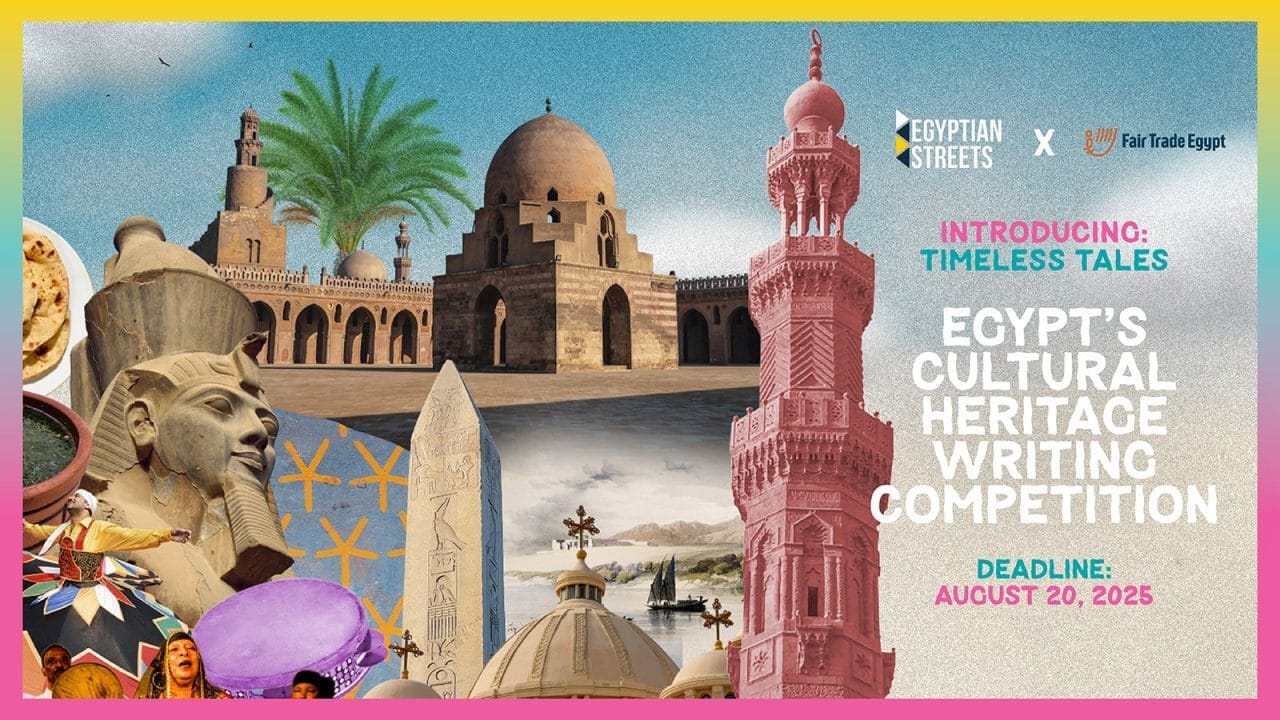
2025 Writing Competition
If you've got a tale to tell about exploring historical sites, attending a performance, or even discovering hidden artisan crafts, we’re all ears! The top three winners will get vouchers from FairTrade Egypt, which can be used to pick out some truly beautiful handcrafted pieces, such as embroidered shawls, unique jewelry, and gorgeous pottery. These items not only showcase the talent of Egyptian artisans, but also FairTrade Egypt’s commitment to ethical, eco-friendly craftsmanship.
The top 10 submissions will be featured on Egyptian Streets, giving writers the chance to showcase their stories to a broad audience. To enter, just send your submission to: [email protected]
Deadline: August 20, 2025
If you have any questions, feel free to reach out to us at [email protected] or [email protected].

Art D’Egypte Art Guide
Art D'Égypte is looking for art lovers to join their team of Art Guides for this year's exhibitions. The guides are a key part of our community, and they provide them with mentorship and training to prepare them for their role. As a guide, you will receive an accredited participation certificate from Art D’Égypte and UNESCO, along with financial incentives. You'll also get to attend special workshops with renowned Egyptian artists, receive transportation to and from the exhibition sites, and have the chance to engage with both the local and international art scene.
Feature

Speaking to the Dead
In a unique folkloric tradition of rural Egypt, women used poetry and mourning songs known as "al 'adid" to communicate with the deceased. Because for Egyptians, speaking to the dead can be as familiar as speaking to the living. Even in their deepest mourning, they reach into the underworld and draw life back out.
These women, much like ancient Egyptians who believed death was a journey rather than a final end, used their words to reach into the afterlife. The poems, with their repetitive verses, were a form of salvation, a way to hold grief in place and see a different reality. The act of making coffee or preparing lunch becomes a way to gently pull the deceased back into existence and have moments of connection.
There are countless ways to mourn, but the rural women of Egypt mourned differently, even poetically. Mourning, for them, was an invitation to step into their own imaginations and, in doing so, finally see the world for what it truly is: a representation of what exists in our minds. The more they imagined, the more they healed, and the more they defeated mourning.

Egypt’s Visual Culture
For decades, women have been shaping the visual culture of Egypt, a fact that has largely gone unnoticed. In villages like Akhmim, women have been weaving high-quality wool and linen textiles, not just as a source of income, but as a way to pass on a legacy of creativity.
Their work, a spontaneous reflection of their surroundings and daily lives, is deeply influenced by their rural heritage. Artists like Ayda Kamal and Amal Elia use their textile art to depict the beauty of rural life and the connection between people and nature.
To honor and preserve this artistic heritage, which links nature, women, identity, and tradition, researchers suggest blending this traditional visual art with modern textile printing techniques to ensure that the unique and beautiful crafts created by these women don't fade into oblivion.
What to Read

NOUR
In his poetry publication NOUR, created with WePresent, Sudanese-Canadian artist Mustafa the Poet, along with contributors like Pedro Pascal and Channing Tatum, meditates on how faith finds a place in our modern world. Drawing a parallel to the Qur'anic verse "light upon light," Mustafa interprets light as a gentle and endless metaphor for God's presence.
The publication explores the tension between faith and a world of destruction, using the imagery of light outlasting and emerging from fire. A conversation between Mustafa and writer George Saunders highlights the continuous nature of spirituality as a process of returning to a sacred state, a concept Saunders simplifies as having "God in me."
Photographs by Yasin Osman throughout the book illustrate that prayer is not always a formal ceremony, but can be found in the everyday moments of life. Ultimately, the publication concludes that prayer is about returning to a luminous and sacred space within ourselves.
Business as usual? No thanks.

The problem with most business news? It’s too long, too boring, and way too complicated.
Morning Brew fixes all three. In five minutes or less, you’ll catch up on the business, finance, and tech stories that actually matter—written with clarity and just enough humor to keep things interesting.
It’s quick. It’s free. And it’s how over 4 million professionals start their day. Signing up takes less than 15 seconds—and if you’d rather stick with dense, jargon-packed business news, you can always unsubscribe.
What to Listen

TUL8TE's ‘Narein’
Expanding his sound into a more emotional and bold territory, TUL8TE's latest album, "Narein," has just been released, and is a fusion of old-school Egyptian pop with modern production. A key highlight is the collaboration with Amir Eid on "Oyoun El Nas," which blends distinct vocal styles and shows the diversity of the Egyptian music scene. It is the summer album we didn't know we needed, and is a great listen for those seeking fresh heartbreak anthems.
What to Watch


220 Days
This psychological romantic drama centers on a couple, Mariam and Ahmed, whose stable relationship is put to the test. Ahmed must confront a health issue just as Mariam discovers she is pregnant, forcing them to make difficult choices. While every relationship faces challenges, it has been some time since an Egyptian series focused so intently on a couple navigating their troubles together.

Rewriting Arab News
Journalism is more than just covering the news; it's also about analyzing it and deciphering what's happening in the world. "Rethinking Arab News" is a documentary that chronicles how journalism in the region has evolved. The film arrived at a pivotal moment when the Arab world was embracing new approaches to rethink journalism and reclaim control of its own narrative.
What to Eat

Treats for Long Summer Days
Whether you're melting in Cairo or soaking up the sun in Sahel, summer is the perfect time to take a break from cooking over a hot stove. That’s why we’ve teamed up with Breadfast to share some of our favorite seasonal picks that are refreshing, satisfying, and just a few taps away. And yes, Breadfast now delivers to Sahel, making your summer meals even easier.
Let’s start with breakfast. We’ve been hooked on Greek yogurt with honey, granola, and fresh mango slices. It is cool, creamy, and just sweet enough to feel like a treat. Add a croissant (or two) on the side, and you’ve got a morning ritual that actually makes getting out of bed worthwhile.
When lunch rolls around, go bold with the Spicy Chicken Sandwich. The crispy chicken, tangy pickles, and fluffy bun make for the perfect combo. Want to keep it local? Add roomi cheese fingers or a side of chilled watermelon. Prefer something lighter? Try the Apple Chicken Salad, where crunchy green apples, a zesty mustard dressing, and smoked almonds come together in a fresh, smoky, and tangy mix we can’t get enough of.
For snacks, Breadfast’s Dark Chocolate and Seeds Granola Bars are a go-to when we’re feeling peckish. Or grab carrot and celery sticks with peanut butter for something a little more wholesome but just as satisfying.
Now for the best part: dessert. The Mango Pudding, made with handcrafted vanilla wafers and juicy mango chunks, is as good as it sounds. And for a cooler twist, we love the Iced Mango Matcha Latte. It is a smooth summer sip that blends Egyptian mangoes with earthy matcha.
And if you’re a purist? Go straight for fresh mangoes - from Owais and Zebida to Seddika, Naomi, and Sukary. You can even skip the slicing and order ready-to-eat mango chunks, perfect for poolside nibbling or movie-night snacking.
All of these are just a few taps away on Breadfast, whether you’re staying cool in Cairo or enjoying the waves in Sahel.

Cavalariça
Cavalariça started in a small Portuguese village and is known for its amazing food and unique dining experience. It has been recognized by the Michelin Guide and the Guia Repsol for its creative menu, which is inspired by the local area and tells a story.
The new Egyptian location will bring that same warm and artistic feeling to a sunny beachside spot. It will focus on creating a memorable atmosphere and connecting with the local culture, all while keeping the brand's signature spirit alive. This new spot will be an entire experience dedicated to upscale coastal living. You'll find everything from sea-view dining and a lively bar to shaded lounges and a curated fashion boutique. To complete the vibe, there will even be sunset DJ sets. The menu will also highlight seasonal ingredients from local producers, and the space will feature work from local artists.
What to Visit

Anthology 2025
Looking back on the past season and ahead to the summer months, Safarkhan Art Gallery presents the second edition of its Anthology series. The exhibition began on June 1st and will run until September 17 with new works being added periodically.
Anthology 2025 showcases some of the gallery’s top resident artists alongside familiar guest names, and it also introduces two new artists to Egypt's art community for the very first time. The collection features a wide range of mediums, including sculptures, photography, fabric appliqués, mosaics, and various forms of painting.
The exhibition brings together new pieces from established Safarkhan artists Ibrahim Khatab, Ahmed Saber, Karim Abd Elmalak, Katherine Bakhoum, Neama El Sanhoury, Omar Abdel Zaher, and Tasneem El Meshad. They are joined by master calligrapher Mohamed Hassan, Fayoum painter Mohammed Hussein, conceptual photographer Jerome Tisné, and the Mosaics of Dahshur atelier, whose debut exhibition King's Lake was a highlight of the past season.

Summer Ciné-Club
Kalam Aflam’s "3al Shatt" program is a four-part film series exploring the deep connection between Arab and North African communities and their surrounding coastlines, from the Atlantic to the Arabian Sea. It presents the sea not just as a physical landscape, but as a space of memory, longing, encounter, and often danger. Through a curated selection of short and feature films by emerging filmmakers from the region, "3al Shatt" examines themes of migration, belonging, nostalgia, and resilience.
The series highlights the cultural and political weight of these waters that both connect and divide. Each screening will be held at Point Éphémère in Paris from August 7 to September 3, 2025, and will be followed by a discussion about the film's themes.
Saudi Spotlight

For Coffee Lovers in Riyadh
Ralph's Coffee, the café from designer Ralph Lauren, has opened its first official location in Saudi Arabia.
You can find the new café in Riyadh's King Abdullah Financial District (KAFD). This permanent store follows a successful pop-up that the brand held last year.
The café has a distinct look, with a classic green-and-white color scheme, equestrian art, and vintage decorations that create a cozy and inviting feel. A huge teddy bear in a white apron greets guests at the entrance, and a retro coffee cart adds to the nostalgic atmosphere.
Inspired by its other locations in major cities like New York and London, Ralph's Coffee brings an international flair to Riyadh. The menu includes a variety of drinks, from the special Ralph's Roast coffee blend made with organic beans to refreshing options like Iced Matcha Lattes and Cold Brews.